MQP – Improving Job Matching through Skill Elicitation
Back to all projects
Project Overview
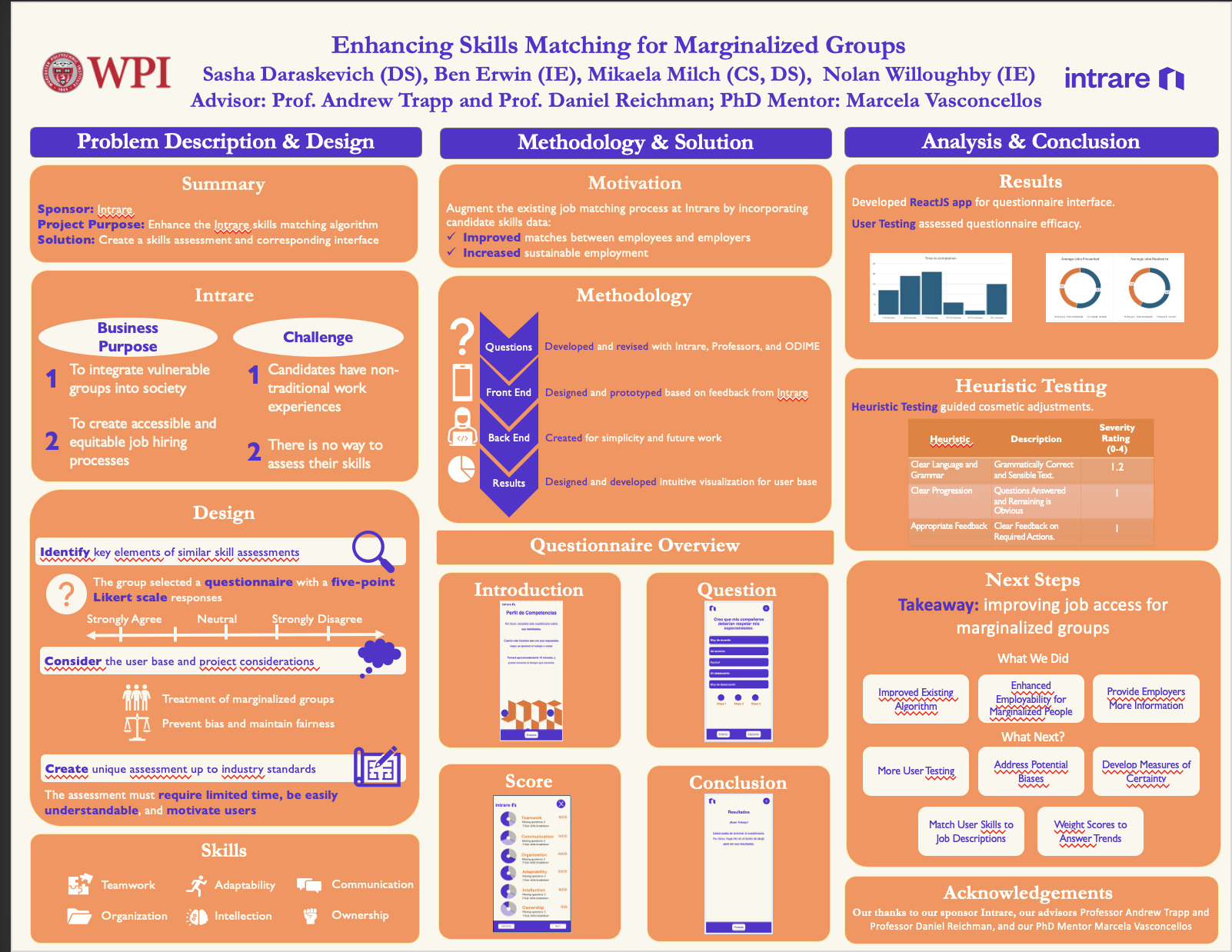
For our Major Qualifying Project, we worked with Intrare, a social start-up in Mexico City, to improve job-matching for members of historically marginalized communities, including refugees, migrants, single mothers, people recently released from incarceration, and members of the LGBTQ+ community. Specifically, our group was tasked with creating a skills consideration for the company's existing integer programming-based matching algorithm. This led to the creation of a skills assessment and associated front end user interface. Because of the nature of the user base and high impact potential of the service, special attention was paid throughout development to ensuring fairness and accessibility in the final product.
As with most similar projects, our work began with a literature review. Research included existing job-matching techniques, skill assessment and matching, the history of marginalization, and recommendations on the use of analytics in contexts with historically marginzalized groups. Within this last topic, additional research was performed on the topic of algorithmic fairness. Our research primarily involved reading literature, though we also conducted several expert interviews, specifically with a professor with knowledge in human resources and hiring; a PhD candidate studying algorithmic fariness; and a member of WPI's Office of Diversity, Inclusion, and Multicultural Education.
The next step, naturally, was formulating the skills elicitation and consideration. Our group identified several soft skills of interest in consultation with the team at Intrare. From there, we conducted further research on how those soft skills are typically assessed to create a Likert Scale-based questionnaire. The answers from these questions were then used to create a skill score across each of the six skills considered, which could then be fed to the matching algorithm as coefficient scores informing the suitability of matching a given candidate to a given job. With what time remained in the project, we prioritized the development of a front-end user interface for the questionnaire, as the team at Intrare indicated this was teh task which would provide them the highest utility.
Personal Reflection
This project was a positive experience in many facets. The first of these was the then novel experience of conducting academic research with an external sponsor. The entire experience highlighted the importance of maintaining consistent, direct communication with external stakeholders, and Intrare's input, suggestions, and subject area expertise were critical to the project's success. Having a sponsor with a mission like Intrare's also proved a consistent motivator. Broadening the scope, the entire project was defined by the consistency with which we met within the group, with our supervisors, and with the sponsor Intrare.
At least on my end, the bulk of the final product felt like a true team effort. While we each had responsibility for giving certain sections a rough draft (my primary literature review focus was marginalization and considerations for analytics with marginalized groups; if i remember right, my primary questionnaire drafting involved questions for the adaptability and ownership skills), it felt like everyone had a hand in refining rough drafts into something presentable as a final draft. The main exception to this would have been the front-end for the questionnaire, which fell to Mikaela as her qualification for her computer science double major.
While our research was certainly related to our degrees in industrial engineering, data science, and computer science, our original work felt more tangentially related. Yes, we worked with the knowledge of the context in which our work would be used in mind, and therefore did what we could to ensure that it could easily integrate into Intrare's existing data pipeline and integer program and that it would be well-adapted for use with the intended userbase. However, at the end of the day, the tangible thing to which we could point that we made was a skills assessment and corresponding interface, neither of which felt as directly related to my industrial engineering studies as perhaps originally would have been expected.
The biggest takeaway and influence of this project was the intense focus placed on fairness and the ways in which Intrare's target demographic would interact with and be impacted by our work throughout every step of the project. We were well aware of the fact that many of Intrare's users had no formal job experience, had intense time constraints, and lacked the same internet and technology access to which we as a group were accustomed. This influenced the skills we chose to assess, the framing and number of the questions we asked to assess them, and the way in which we designed the front-end. No decision was made without considering what the implications would be for an already vulnerable userbase. Beyond any technical takeaway, this diligent focus on accessibility and equity had the most lasting impact of any one aspect of the project.
Downloads
Written Report (PDF)
This report is also published in WPI's Digital Collection at this link
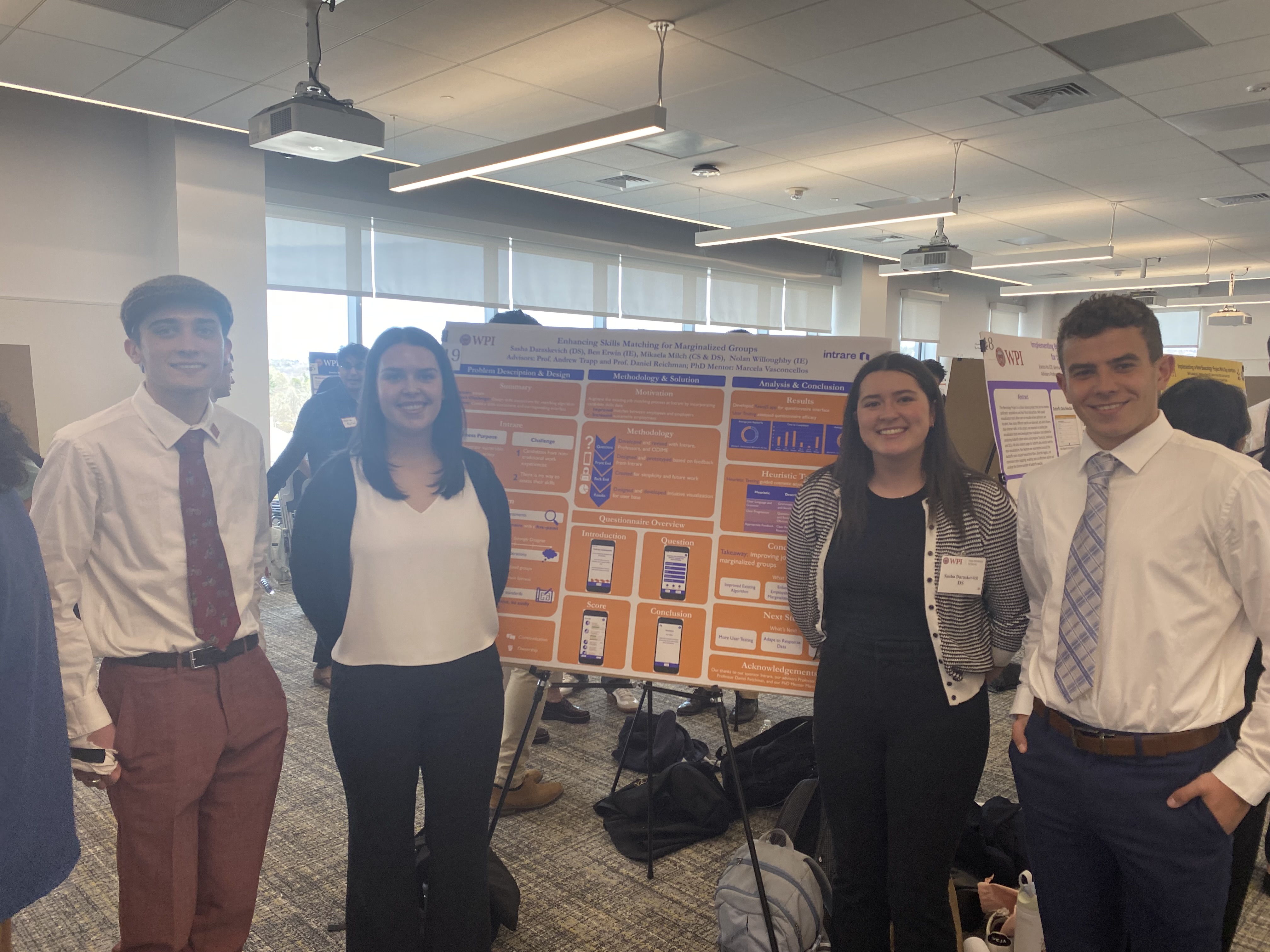
Poster (PNG)
Unfortunately, I no longer have access to the original poster. My best resource for that particular artifact is this screenshot